

How this one started
We didn't pitch GDC. We ran into them.
We were on a job when we noticed the QR codes on GDC's panels — every install they finish carries one, pointing back to their website. So we scanned it, the way a customer would. The site that loaded was slow, and it didn't look anything like the standard of the work sitting on the wall in front of us.
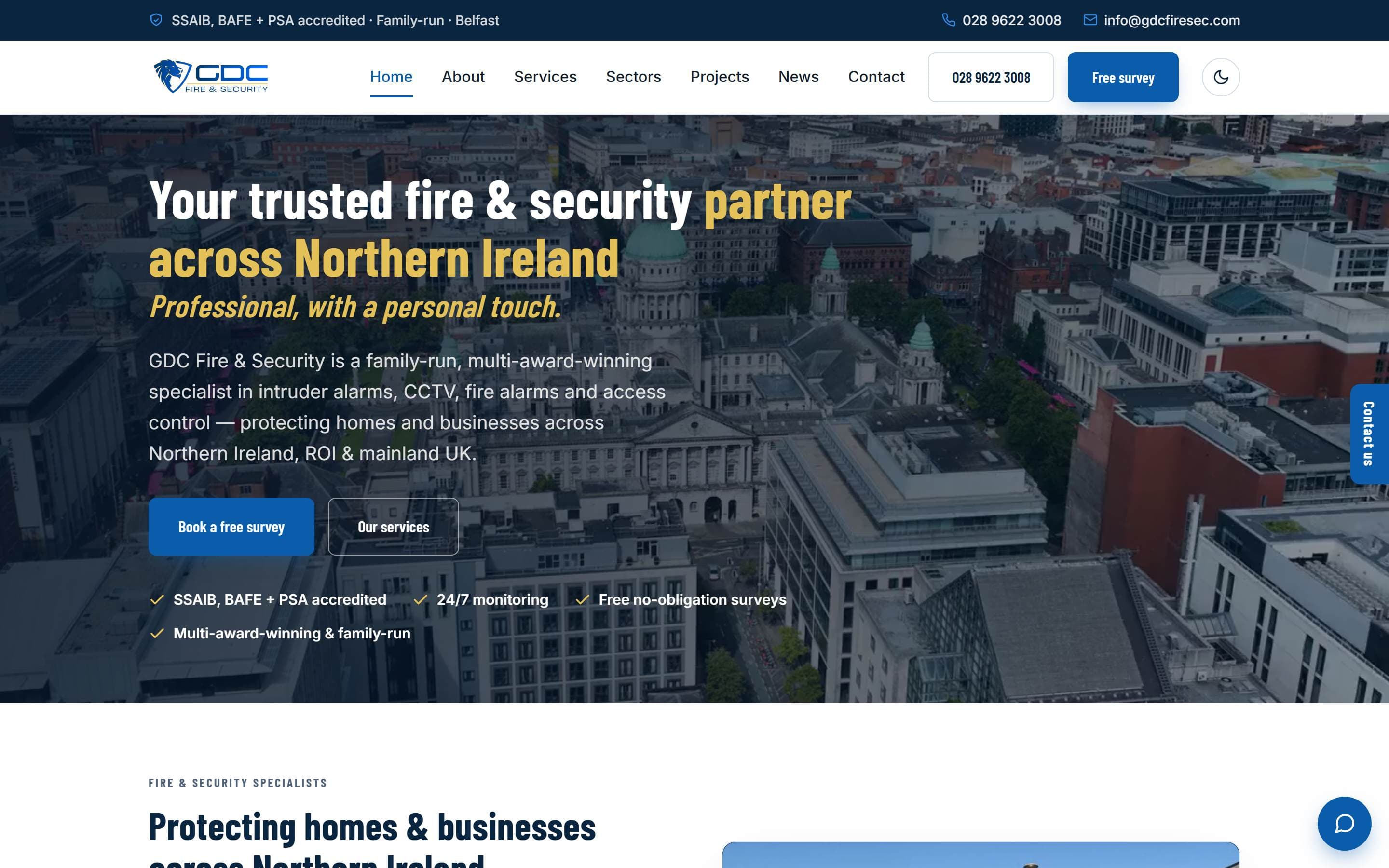
That gap is the whole brief. A firm doing genuinely good work was sending people to a page that undersold it. We approached Gareth about a rebuild under our Contractor Package, and that's the site that's live today.
The client
GDC Fire & Security are a family-run fire and security specialist based in Belfast, working across Northern Ireland, the Republic and mainland UK. Intruder alarms, CCTV, fire alarm systems, access control, emergency lighting, fire extinguishers, risk assessments, 24/7 monitoring.
They're SSAIB, BAFE and PSA accredited, multi-award-winning, and carrying 30 years of combined experience and over 100 five-star Google reviews.
The problem
None of that was reaching anyone online.
For a trade where the customer is handing over responsibility for a life-safety system, the website is the first survey — the point where a facilities manager or a homeowner decides whether this firm looks like the one to trust. GDC's credentials were their strongest asset and their old site buried them.
There was a second, quieter problem: nothing on the site could be updated without going back to a developer. A firm that finishes new installs every week had no way to show any of them.
What we built
37 pages, written from scratch. No page builder, no theme, no plugins — plain HTML, CSS and vanilla JavaScript. The whole site is 68KB of CSS and JavaScript combined, with no dependencies to update, break or get exploited.
A page per service, not a list. Twelve individual service pages — fire alarm systems, fire alarm monitoring, fire risk assessments, fire extinguishers, emergency lighting, disabled refuge, intruder alarms, intruder monitoring, CCTV, access control, and the two category hubs. Someone searching for one specific thing lands on a page about that specific thing.
Six sectors, each with its own page. Residential, commercial and retail, industrial and manufacturing, hospitality and licensed premises, education and public buildings, apartments and multi-tenant.
Fifteen project case studies. Every one structured the same way: the client brief, what GDC delivered, the systems installed, and photographs taken on site. Queen's Quarter Housing, Ramada Belfast, Hendrix, Tobar Mhuire, Castleridge, Branniff Joinery, KME, Fosters Tyres and more. Each is a page that can rank on its own, and each ends with an invitation to start a similar project.
Local SEO built in, not bolted on. Per-page titles, descriptions and canonicals; LocalBusiness schema listing the NI towns actually served; BreadcrumbList on inner pages; FAQPage schema on contact; a full sitemap.
Details that convert. A quick-contact panel with call and email actions and a mini quote form. On mobile, a sticky call / free-quote bar pinned where a thumb already is. Light and dark themes that follow the visitor's own device setting. Motion that respects reduced-motion preferences, a skip link, ARIA and full keyboard support.
Then we handed over the keys. The site ships with its own editor. GDC can change any heading, paragraph or quote, edit their Google title and description, add or remove projects, testimonials and FAQs, and replace any photo — images are resized and compressed automatically. Changes are live in about a minute. £40/month, optional, unlimited changes.
The numbers
- 37 pages, written from scratch
- 15 project case studies
- 12 individual service pages
- 6 sectors, each with its own page
- 68 KB of CSS and JavaScript, total
- 0 plugins and dependencies
The takeaway
For a specialist trade, a website isn't a brochure — it's the first survey the customer runs on you. GDC had the accreditations, the reviews and the work. The job was to put all three in front of anyone who looks, and then get out of the way with a free-survey button on every page.
The QR code on the panel now leads somewhere worth landing.